 PLATE + FIT
You don’t need a kitchen scale to eat balanced meals. Your hand is already the right size for your body, and it travels with you to every meal — the ones at a friend’s house, at a restaurant, or standing at the kitchen counter at 9pm. Portion sizes using your hand work because hand size scales fairly closely with overall body size, so the same landmarks give a workable estimate whether you’re petite or tall, athletic or not. This guide walks through the four hand measurements that stand in for protein, vegetables, carbohydrates, and fats, why they hold up across different body types, and how to combine them on a single plate. By the end, you’ll have a portion system you can use anywhere — no scale, no app, no guesswork.
What Is the Hand Portion Method?
The hand portion method is a way of estimating food amounts using four parts of your own hand as built-in measuring tools: your palm for protein, a closed fist for vegetables, a cupped hand for carbohydrates, and your thumb for fats. Instead of weighing food or counting grams, you compare what’s on your plate to the size and thickness of these hand landmarks.
It’s the same idea behind the healthy plate method, just without a physical plate in front of you. Where the plate method divides a fixed surface into halves and quarters, the hand method gives you a portable version of the same ratios — useful when you’re plating food at a buffet, ordering at a restaurant, or packing lunch in a container that isn’t divided at all.
Dietitians and nutrition coaches have used hand-based estimation for years precisely because it doesn’t require any equipment. You always have your hand with you, it doesn’t need charging or calibrating, and it scales automatically to your own body — a benefit a printed chart or a generic gram target can’t offer.
The trade-off is precision: hand measurements are an estimate, not a lab-accurate figure. For most people building everyday eating habits, that’s the point. The method is meant to replace no portion awareness with a rough, repeatable one — not to replace the same accuracy a food scale gives a competitive athlete or someone following a clinician-directed meal plan.
The method shows up most often in sports nutrition and general wellness coaching, where the goal is a habit someone can keep for years rather than a number they track for a few weeks. A traveling salesperson eating three restaurant meals a day, a parent portioning dinner for a family of five, or someone simply tired of weighing chicken breast on a kitchen scale — all three can apply the same four landmarks without carrying anything extra.
Why Hand Size Works as a Portion Guide
Hand size tends to track with overall body size and, loosely, with energy needs. Someone with a larger frame usually has a larger hand, and a larger frame generally needs more food to feel satisfied and maintain energy through the day. That correlation is the entire mechanism behind the method — it’s a proxy, not a precise formula, but proxies can be useful when they’re easy to use consistently.
The Harvard T.H. Chan School of Public Health’s Healthy Eating Plate makes a similar point about portion awareness in general: the proportions of food groups on your plate matter as much as the specific foods themselves. Hand measurements are simply a way to carry those proportions with you when there’s no plate to look at.
A few things make the method more or less reliable in practice:
- It works best for solid, plateable foods — chicken breast, rice, roasted vegetables — and less well for liquids, sauces, or foods eaten straight from a bag.
- It’s a starting point, not a fixed rule. Appetite, activity level, and the rest of the day’s meals all still matter.
- It’s most useful for the meals where you have the least structure — eating out, travel, potlucks — not necessarily for a home-cooked dinner you already portion by habit.
- Thickness matters as much as surface area. A thin slice of salmon covering your whole palm is not the same portion as a thick one the same size.
None of this requires precision to be useful. The goal is a consistent mental habit you can apply in ten seconds, not a substitute for individualized guidance from a qualified professional when that’s what a situation calls for.
A quick way to see it in action: picture a dinner plate at a friend’s house with grilled chicken, roasted potatoes, and a green salad. Instead of guessing, you glance at the chicken against your palm, the potatoes against a cupped hand, and the salad against a fist or two. It takes a few seconds, and after doing it for a couple of weeks, most people find they no longer need to consciously check — the landmarks become an internal sense of what a balanced plate looks like.
How to Estimate Portion Sizes Using Your Hand

Here’s how the four landmarks typically map to a plate, assuming a standard meal built around protein, vegetables, and carbohydrates. Try this at your next meal before you reach for a serving spoon on autopilot — comparing the food to your hand first, then adjusting, is the whole habit.
- Palm = protein. One palm-sized, palm-thick portion of protein — chicken, fish, tofu, eggs, legumes — per meal. Measure the surface area and the thickness both; a thin, sprawling cutlet isn’t the same portion as a thick one.
- Fist = vegetables. One closed fist of non-starchy vegetables — leafy greens, broccoli, peppers, zucchini. Because vegetables are low in calorie density, most people can go up to two fists without overshooting a balanced portion.
- Cupped hand = carbohydrates. One cupped handful of starchy carbohydrates — rice, pasta, potatoes, oats, whole-grain bread. This is where portion size varies most by activity level; a very active day can reasonably call for two cupped handfuls.
- Thumb = fats. One thumb-sized portion of added fat — a thumb of peanut butter, a thumb-length drizzle of olive oil, a thumb of butter. Fats are calorie-dense, so this is intentionally the smallest of the four landmarks.
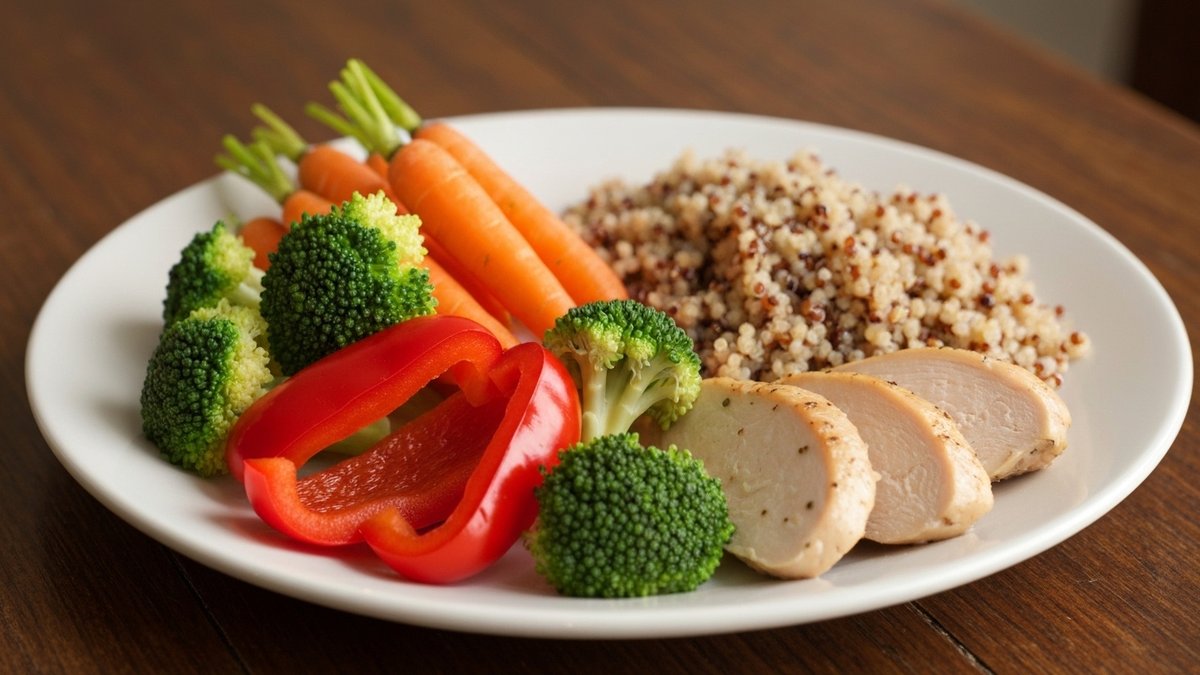
Put together, a typical plate looks like one palm of protein, one to two fists of vegetables, one cupped hand of carbohydrates, and a thumb of fat — which lines up closely with the same 50/25/25 proportions used in plate-based portion methods, just measured differently. Start by applying it to one meal a day, get a feel for what your usual portions actually look like against these landmarks, and expand from there once it’s automatic.
The most common mistake isn’t picking the wrong landmark — it’s comparing food to the widest part of your hand and ignoring depth. A palm-sized portion of salmon that’s an inch thick holds a lot more than a palm-sized portion that’s a thin fillet spread flat, even though both cover the same area. Checking thickness alongside surface area, especially for the palm and thumb measurements, keeps the estimate closer to accurate.
From Hand Measurements to a Portion Plate
The hand method is portable, but it does ask you to do a small mental calculation at every meal — how big is a fist relative to what’s already on my plate? A portion-control plate removes that step for meals eaten at home by printing the same proportions directly onto the plate, so the vegetable, protein, and carbohydrate sections are already marked out before you start serving.
The two approaches aren’t in competition — they solve the same problem in different settings. Use your hand when you’re out and there’s no marked plate in sight; use a marked plate at your own table when you want the visual guide built in, with zero mental math required. Many people start with the hand method because it’s free and immediate, then add a physical portion-control plate once they’ve decided the habit is one they want to keep long-term at home.
The two also reinforce each other. Practicing portion sizes using your hand for a few weeks builds the underlying sense of proportion — what “a quarter of the plate” actually looks like — so that when you do sit down to a marked plate, the sections feel intuitive rather than like a new rule to follow. And on the days you eat away from that plate, the hand-based habit is still there, unchanged.
FAQ
Is the hand portion method accurate for everyone?
It’s a reasonable estimate for most adults because hand size correlates loosely with body size, but it’s not lab-accurate. People with unusually small or large hands relative to their frame may find the ratios run slightly high or low, which is fine to adjust by eye over time.
Should I use my hand or someone else’s hand to measure portions?
Always your own hand. The entire premise depends on hand size scaling to your own body size — borrowing someone else’s measurements defeats the purpose.
Does the hand method work for weight management goals?
It can support portion awareness as part of a broader approach to eating patterns, alongside food quality, activity, and sleep. It isn’t a stand-alone plan and isn’t a substitute for individualized guidance from a healthcare provider when that applies.
How is this different from the healthy plate method?
Both use the same rough proportions — roughly half vegetables, a quarter protein, a quarter carbohydrates. The plate method uses a physical plate divided into sections; the hand method uses your hand as a portable stand-in when there’s no plate to reference, like at a buffet or while traveling.
What foods don’t work well with hand measurements?
Liquids, sauces, dressings, and foods eaten straight from a package (chips, nuts, dried fruit) don’t map cleanly onto palm, fist, cupped hand, or thumb. For those, a small bowl or a quick glance at the packaging serving size is more useful.
Key Takeaways
- Palm = protein, fist = vegetables, cupped hand = carbs, thumb = fat.
- Hand size scales with body size, so the method self-adjusts per person.
- Best for meals without a marked plate — eating out, travel, buffets.
- Thickness counts as much as surface area for palm and thumb portions.
- Pairs well with a portion-control plate for meals eaten at home.
Once the hand method feels natural, a marked plate can make the same proportions effortless at every home meal.
See the portion-control plate and skip the mental math at your own table.